

Black Gold

“Hardly anything is as exciting or as diverse, as strong a confirmation of life and hope and the universe’s urge towards creativity, as a lively compost heap or the first draft of a novel.”
MARGARET SIMONS
Resurrection in a Bucket: The Rich and Fertile Story of Compost
It still seems like a kind of magic trick to me, that with a pile of kitchen scraps that might otherwise be thrown in the bin; a few potato and carrot peelings, some eggshells and used teabags, torn up pieces of cardboard and newspaper, mixed together with some weeds and leaves from the garden and left alone for a while, somehow turns into rich, crumbly, black compost, perfect for the garden beds and potting shed. It’s like when the mice in Bagpus make chocolate biscuits from breadcrumbs and butter beans. It’s a clever and cunning trick right? Or like the tooth fairy that turns out to be your parents, one day I’ll discover that little magical creatures are taking my compost ingredients away in the middle of the night and replacing them with mounds of rich compost.
I know not everyone has a garden, but I don’t understand why everyone doesn’t make compost. If food scraps get thrown in the bin, they get sent to landfill, where they produce methane and contribute to global warming, so I’d love to see communal compost bins that neighbours could all add to and benefit from. At least these days, most councils take green waste away to be composted, which is some kind of progress, but I’m sure we could be doing more. I’m pretty sure we should all be composting our human bodily waste too, to save water and resources (don’t even get me started on sewage overflows going into rivers), but our homes and our sensitive temperaments around such things are not there yet, but I fully admire those who do.

If you’re reading this and you don’t compost, and you too think it’s some kind of trick that us gardeners perform with a sleight of hand, or maybe you think it’s complicated, or a lot of effort, or that it’s smelly and dirty and horrid, then I’m here to correct you on all those points.
This magic trick is actually performed by that wondrous thing called nature, the master spellbinder. The original expert in recycling. It’s a collaborative teamwork effort of microorganisms (bacteria and fungi) and other creatures who arrive on the scene as if from nowhere, ready to break down any natural material into soil. But not just any old soil, this is what us gardeners call ‘black gold’. It’s like the difference between a stale, dry cracker and a gourmet, nutritious-rich meal. It’s the stuff of life, quite literally.
Organic matter is what soil needs to thrive, to replenish and feed the plants that grow in it, in much the same way that our bodies need to be watered and fed. Yes, you can bypass the middleman and add chemical fertilisers directly to plant roots, but (as I think I wrote in one of my previous posts) it’s like giving someone a vitamin pill instead of a nutritional meal. It doesn’t feed the microbes, which work to keep us and them healthy in so many other ways.
Compost is essentially made from 4 ingredients; 1: nitrogen-rich green waste (leafy green stuff from the garden, or veggie scraps from the kitchen), 2: carbon-rich brown waste (cardboard, paper, brown leaves or stems from the garden, even hair or nail clippings), 3: water or moisture (some of which comes from the green waste), and 4: air.
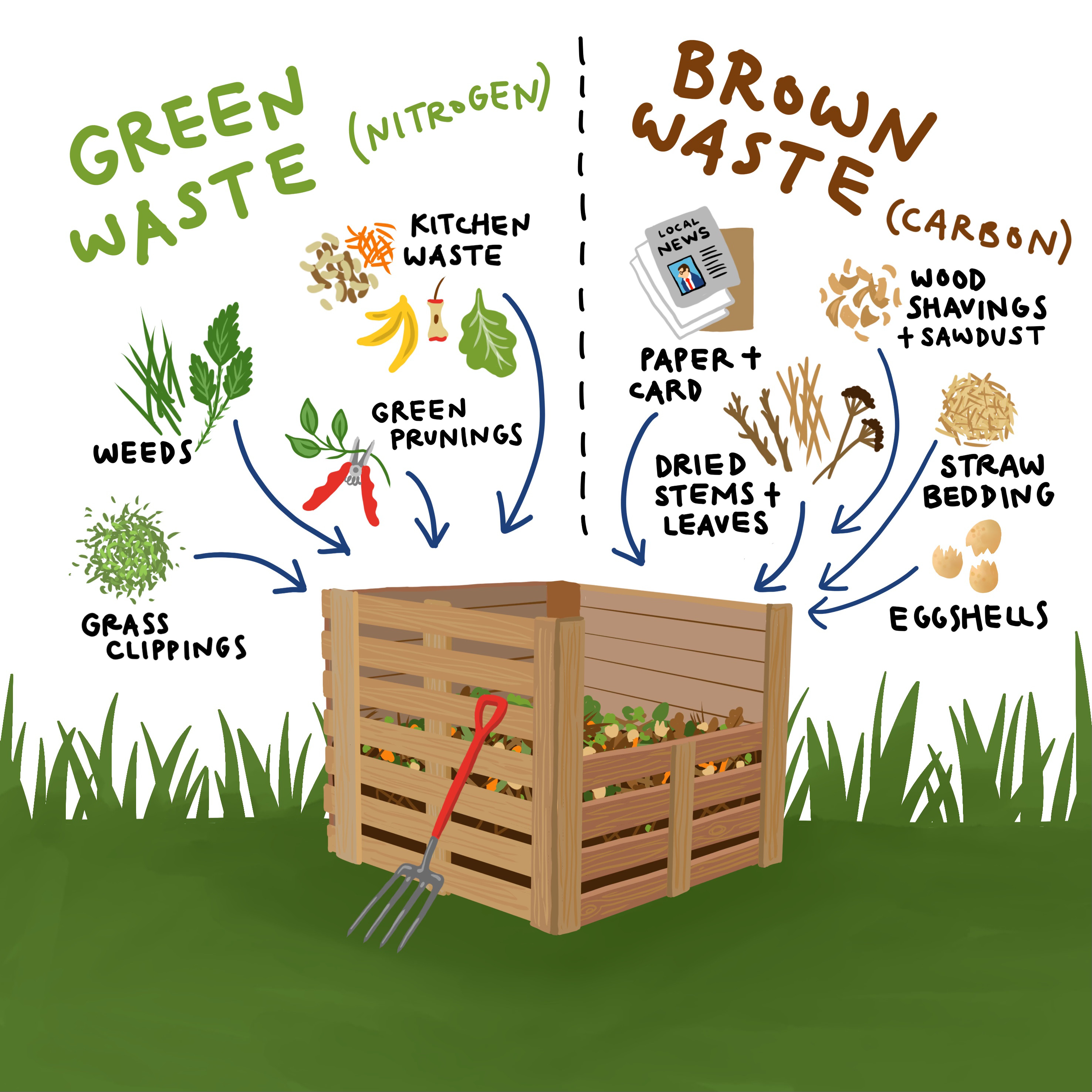
Some people worry too much about getting the mix right. I just try to keep it all in balance, a bit more brown than green if possible, and throw over some water if it looks too dry. Also, some people obsess about the turning of compost. Okay so, in an ideal world, you’d have several composting bays lined up so that you can turn one into the next, until you have compost like you’d buy in bags from the garden centre. But not all of us have the space for this. Even on my allotment, where I do have space, I regrettably have never been organised enough to get hold of enough wooden pallets and enough spare time and effort and skills to construct such things. So kill me now, but I don’t turn my compost, I just give it all a little poke and shuffle around occasionally to get some air in there, and let the worms and other critters do it for me. It just takes a bit longer, and it might be a bit rougher, but that’s okay with me. I sieve it if I really need to, and throw any uncomposted bits back into the bottom of the bin.
Nature will do the job for you in time. I mean, does anyone go into the woods to turn the leaves and broken stems so that nature’s own compost bin (i.e the forest floor) gets made into perfect loamy compost?
No, it’s the job of the worms, helped along by the ants, beetles, woodlice, earwigs, leatherjacks, millipedes and centipedes, billions of microscopic creatures I could never name (it would take me a while), nematodes, single-celled Protozoa, the aforementioned bacteria and fungi in varieties and quantities I can’t even find through research! I’m pretty sure it’s more than there are stars in the sky (correct me if I’m wrong), and they’re working together all the time in perfect harmony like a beautiful symphony, to create this stuff that allows plants to grow and our planet to thrive and enable life.
Recycling death back into life, it’s what nature does best.
There are many types of compost bin, I’ve had several over the years, and many trials along the learning curve of compost making, but mostly they’ve all done the job. Plastic dalek-shaped bins, wooden slats-that-slot-together bins, a homemade scrap wood and chicken-wire (eventually held together with ivy) bin, and my latest and best, a hot bin. I also have one on my allotment which is technically called a ‘pile it all up in a corner and hope for the best’ style bin. Okay - heap! So you don’t even really need a bin at all. You can also dig a trench or pit in the ground where you’re planning to grow future crops, and throw your organic matter straight in there, cover it back over with soil and let the worms and co. work their magic. Often, our rougher compost is added to the potato trenches, where it continues to break down while feeding the potatoes as they grow.
I have also seen an amazing system online where a series of wooden posts (or branches) are hammered into the ground in a large circle, with thinner branches woven in and out of them to create a kind of huge basket that acts as the compost bin, and then a border around the outside gets planted up with edible crops. A few stepping stones lead into the central bin on one side for access, and it gets filled up with the usual compost materials. The idea being that all the goodness from the compost seeps down and into the surrounding border to feed the plants. Genius.
One of the major issues with compost bins / heaps is the attraction of rats to the kitchen scraps. Hence why eventually I invested serious money in a rat-proof hot bin. It has been well worth the investment, as not only has it solved the rat problem, but it also makes fantastic compost in a much shorter spell. It has now turned into more of a worm bin, which is amazing considering it’s raised up on bricks, and I never threw any worms in there, somehow they have found their way in and colonised it, but they’re doing a great job for me, so I pay them handsomely in food scraps and say hi to them each time I open it, which I’m sure they appreciate. When it gets cold, they burrow down into the warmer depths of the heap, but on a warmer day, they rise up, and if it gets properly hot, I leave the lid open for a while so they can escape if necessary, which they do.
I get some amazing fungi in there, depending on what I’ve thrown in and the temperature and moisture levels. I’ve seen things you people wouldn’t believe. Towering columns of furry white strands, yellow and orange jelly-like blobs, and organisms that look like something from a sci-fi movie. I never quite know what I’m going to find.
A lot of seeds make it through. A few days or weeks after spreading it onto the allotment, I get mostly tomatoes sprouting up everywhere. Last year I left most of them to grow as it saved me the effort of sowing and transplanting them myself.
The compost from my allotment bins is always much drier and rougher because there’s less moisture, since it's mostly fed with garden waste rather than kitchen waste. It gets used as a mulch, or added to the very bottom of the potato trenches or planting holes, where it hopefully absorbs any excess moisture.

I’m writing this on a wet day in January, hoping that tomorrow will bring a break in the weather so that I can get outside and empty out the bottom section of the hot bin. I can’t fit any more waste in at the top, and the bottom section is bulging. The worms have started to push compost out of the smallest of gaps at the sides, which is an unsubtle hint from them that it needs emptying. It’s not a particularly difficult job, a bit messy, yes, but not unlike any other gardening job, and I get to be amazed by the numbers in my worm colony. Some of these worms inevitably end up shovelled into the old compost bags that I have been keeping for years for this purpose. I hope they find a home on my allotment and survive. I do my best to put as many as I can back into their original home to repopulate.
As with all of my gardening endeavours, composting has been a learning curve through trial and error. I have learnt to be wary of ‘compostable’ soft plastics, which are really only compostable under industrial units and not my tiny home bins. Also, cardboard with laminated layers that are hard to spot, I pretty much stick to brown/grey cardboard only and nothing printed. I’m careful not to add too much of any one material without thoroughly mixing it in. Branches that are too thick and anything else too woody - these go into the council green bin. I add water if it looks too dry, more brown material if it looks too wet. Sometimes eggshells make it through intact, they just need to be broken down with the spade, along with avocado stones.
Last spring, for the first time, I started using my own compost for seed sowing and transplanting. It needs to be sieved, and then mixed with some perlite, and I also add in some coir that I buy in dry blocks for rehydrating. It worked fine, you just have to accept that you may get some weed seedlings coming through. So I use it only for sowing larger seeds (courgettes, squashes etc) where I can be sure what is what once they germinate. Definitely don’t use it for tomatoes as you won’t be able to tell the ones you sowed from the volunteers. It’s really better saved for the transplanting stage, as any weeds that come through can easily be identified and pulled out.
Who knew I’d have so much to say on the topic of composting. No doubt my adventures in the land of composting will continue for many more years, as long as I have the back muscles to shift the stuff around. It really is one of the best ways to help take a little more care of our Earth, by using your waste for good, by giving something back to the ground, by feeding the soil and all that lives and grows in it, by resurrecting something back into life.
I hope this has been helpful or that my experiences have rung true for you too. Thanks for reading, and happy composting!
If you’d like to support me in another way, you could buy something small like an allotment greeting card or a ‘Grow Your Own’ keyring from my Etsy store.
It’s a hot topic (so to speak)! There is much discussion at the community garden where I volunteer.. what should be added, what not, should we turn it, etc. Needless to say gardening by community, means not much gets agreed! I’m in the ‘throw it all on’ camp, which seems to work (eventually) for me 😅
This is wonderful, thank you!